
If you have been running construction projects for a while, you already know this situation.
Everything is moving. Crews are on site, materials are coming in, and the schedule looks fine. Then someone works off a drawing that was updated two weeks ago. An RFI sits in an email thread with no follow-up. A submittal comes back rejected because no one checked it against the spec. A permit condition gets missed until an inspector shows up on site.
None of these feels like a big problem when they happen. But stack them up over a 12-month project, and you are suddenly a month behind, over budget, and trying to explain it to an owner.
This is a construction document management problem. Not a people problem. Not a design problem. A systems problem. And it is one that AI in construction is finally starting to solve in a practical, everyday way.
This blog breaks down exactly where these errors come from, what they cost, and how AI in construction is helping teams stop absorbing these losses and start preventing them.
Why does this problem cost more than most teams realize
According to a study by Autodesk and FMI Corporation that surveyed over 3,900 construction professionals, bad data, defined as information that is inaccurate, incomplete, inaccessible, inconsistent, or untimely, may have cost the global construction industry $1.85 trillion in 2020 alone, with decisions made using bad data responsible for $88.69 billion in avoidable rework. (Source: Autodesk / FMI, “Harnessing the Data Advantage in Construction”)
And it is not just the cost of redoing work. It is the time your team spends every single day just trying to find the right information.
A PlanGrid and FMI survey of nearly 600 construction leaders found that construction workers lose almost two full working days every week solving avoidable issues and searching for project information, with the average team member spending 5.5 hours per week just hunting down project data like revised drawings, material cut sheets, and job-related information. (Source: PlanGrid / FMI, “Construction Disconnected”)
That is the time your team is not building. That is your margin bleeding out quietly, week after week.
Where the errors are actually coming from
Most of these documentation problems are not caused by careless teams. They are caused by systems that were not designed to handle the volume and complexity of a modern construction project.
Here are the most common places it breaks down.
Outdated drawings are still in circulation.
When a drawing gets revised, not everyone automatically gets the updated version. A subcontractor who downloaded drawings six weeks ago is still working from the old ones. Work gets done to a superseded spec. Now someone has to demo and redo it.
RFIs that go out without enough context.
When an RFI does not include the right spec sections or drawing references, the architect or engineer has to ask follow-up questions before they can even begin to answer. A question that should get resolved in 48 hours turns into a two-week back-and-forth. Work stalls, or someone makes a field assumption. Neither is good.
Submittals were sent before a proper spec check.
Going through a full spec to verify that a proposed product meets every requirement is slow, manual work. Under schedule pressure, teams skip it or skim it. When the submittal comes back rejected, the material delivery timeline moves back by weeks, and everything downstream shifts with it.
Compliance and permit requirements are falling through the cracks.
Permit conditions, local code requirements, and testing obligations rarely live in a single document. When no one is tracking them systematically, they get missed. An inspector finds them on site, work stops, and the schedule takes another hit.
Rushed vendor prequalification.
Certifications, insurance documents, and safety records exist for every subcontractor. But pulling them together and actually comparing them against project requirements takes time that feels like a luxury when things are moving fast. When the wrong subcontractor shows up on site with incomplete documentation, the cost of fixing it is almost always higher than proper prequalification would have been.
Why the traditional approach hits a wall
Most teams handle construction document management with some mix of a document control coordinator, a shared drive, naming conventions, and checklists. These work to a point. They are just not built for the scale of a modern project.
Coordinators become bottlenecks. Naming conventions only hold when every single person follows them. Manual spec reviews are slow and only as thorough as the time available allows. Checklists catch what they were designed to catch, and nothing more.

The real issue is simple. The volume of documents on a construction project, and the pace at which they change, has grown faster than any manual system can keep up with. Something has to give, and it is usually accuracy.
How AI in construction actually changes this
AI in construction has gone from a buzzword to something teams are using on live projects right now, but most people are struggling with generic AI tools, which don't have construction knowledge trained well.
Here is why that matters.
Generic AI tools are built for every industry. That means they are not built deeply for the construction industry. You can ask your generic AI to draft something that looks like an RFI. What you will get is something that looks like an RFI but has no connection to your actual drawings, no spec clause references, and no construction logic behind it. The risk is not that it tells you it does not know. The risk is that it gives you a confident, well-formatted answer that you cannot actually rely on.
Construction AI agents built specifically for construction work differently. They connect to your actual project documents and understand what is in them.
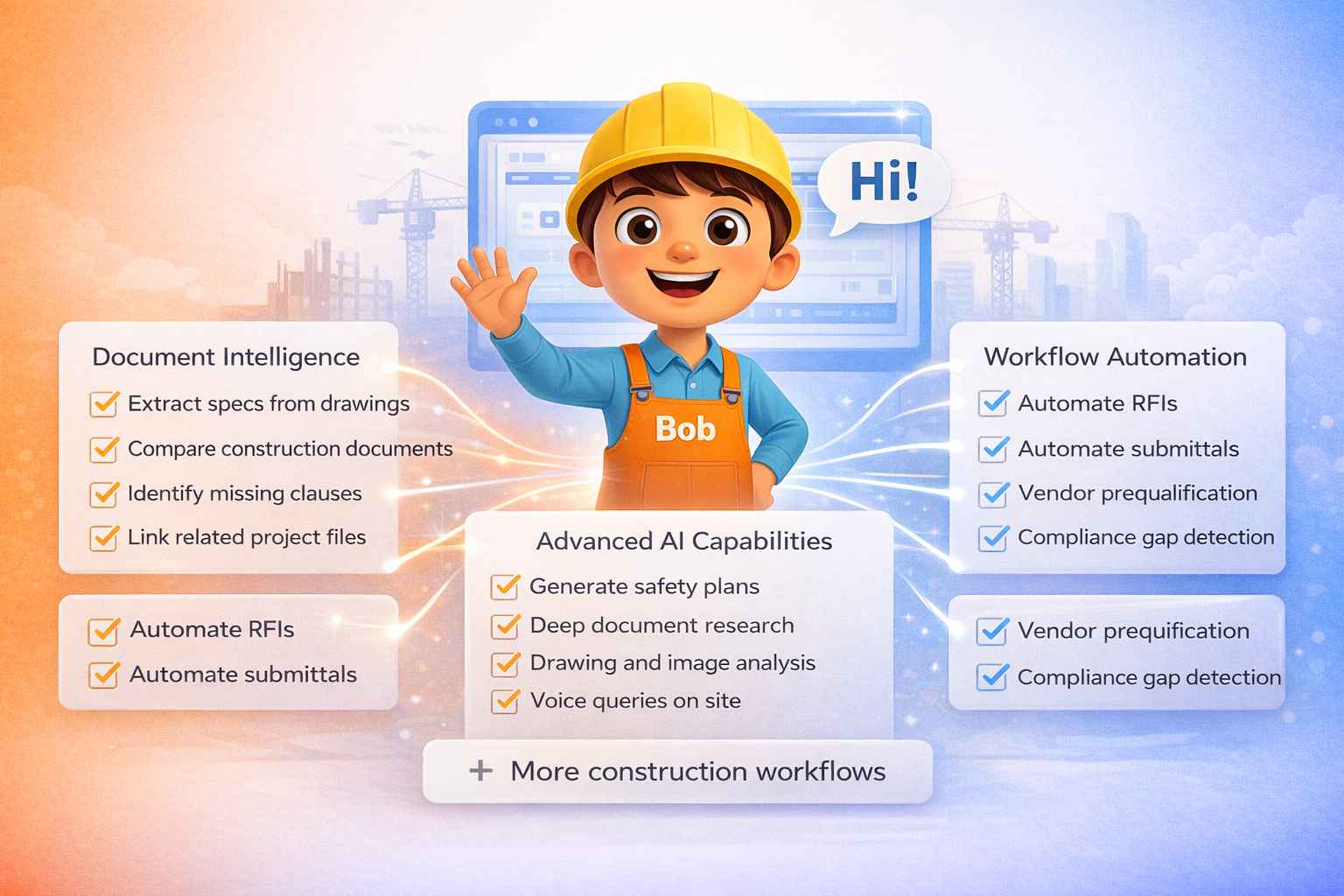
Bob is the construction AI agent built specifically for construction teams. It is not a project management platform. What it does is sit on top of your project documents and give your team a smarter, faster way to work with them.
Here is what that looks like day to day:
- A field supervisor needs to know the required concrete compressive strength for a specific pour. They ask Bob. Bob finds the answer in the spec and shows them the exact source. No hunting, no guessing.
- An RFI needs to go out. Bob drafts it by pulling the relevant spec clauses and drawing references directly from your uploaded documents. The architect gets enough context to respond on the first pass. That is RFI automation that actually works, not just a text generator.
- A submittal is ready to send. Bob checks it against the project specification and flags any gaps before it leaves your hands. One step that can prevent a weeks-long rejection cycle.
- A permit requirement is at risk of being missed. Bob identifies it from your project documents before it becomes an issue on-site.
- And for field teams, Bob’s voice input lets a foreman ask questions hands-free during a site walkthrough and get answers from the project drawings without stopping work. No generic AI construction tools do that in a construction-aware way.
How Bob compares to other AI tools
Capability | Other AI tools | Bob AI |
Construction domain knowledge | None | Purpose-built for construction |
Reads and understands specs and drawings | Generic docs only | Full spec and drawing comprehension |
RFI drafting with spec clause references | Generic drafting only | Auto-pulls relevant clauses from your project documents |
Submittal compliance check | Cannot verify against spec | Compares product against spec, flags gaps before submission |
Permit and compliance gap detection | Not available | Identifies permit needs and code gaps proactively |
Vendor prequalification workflow | No structured workflow | Certifications, safety records, and pricing alignment |
Voice input for field use | Not construction-aware | Hands-free queries tied to your actual project documents |
Integrations | Limited | Procore, SharePoint, Google Drive, and more |
LLM flexibility | Single model only | Multi LLM support |
Outputs built for construction | Generic documents | RFIs, submittals, safety plans, QC checklists, punch lists |
The difference is not subtle. Generic AI tools are horizontal, built wide across every industry. Bob is built deep for construction. Every document it reads, every output it generates, and every workflow it supports is calibrated specifically for how construction projects work.
What your team can do right now
Whether or not you bring in a new tool, there are some process changes that reduce construction document management errors on almost every project type.
Set one source of truth and keep it current.
Every team member and subcontractor should know exactly where the live version of every document lives. When a drawing gets revised, archive the old version and communicate the update directly. Just uploading a new file to the same folder without telling anyone is not version control.
Write RFIs at the moment the question comes up.
The best RFI automation still starts with a quality RFI. Create it when the question is fresh, with the relevant spec and drawing references already attached. Waiting to write it means reconstructing context from memory and slowing down a cycle that is already too long.
Check every submittal against the spec before it goes out.
Build this as a standard step, not an optional one. If a construction AI agent can run that comparison automatically in seconds, use it. A rejected submittal caught before submission saves at a minimum of one to two weeks compared to one caught after.
Give compliance requirements their own dedicated log.
Permit conditions, testing obligations, and code references need to live somewhere visible, with one person responsible for reviewing them at the start of every major phase.
Stick to your vendor prequalification process every time.
No shortcuts, regardless of schedule pressure. Certifications, safety records, and insurance need to be checked against your project requirements before anyone gets on-site.
Frequently asked questions
What is AI in construction used for?
AI in construction is being used for construction document management, RFI automation, submittal compliance checking, permit and code gap detection, vendor prequalification, safety plan generation, and voice-based field queries. The highest-impact applications are the document-heavy workflows that currently take up the most time and produce the most errors.
What is a construction AI agent?
A construction AI agent is an AI tool built specifically for construction workflows. Unlike general AI construction tools, it understands construction specifications, drawing formats, compliance requirements, and construction-specific outputs like RFIs, submittals, and QC checklists. It works directly with your actual project documents, not just generic text.
How does a construction AI agent improve RFI management?
By improving the quality of the RFI at the drafting stage. When a construction AI agent pulls the relevant spec clauses and drawing references from your uploaded documents directly into the RFI draft, the person receiving it has everything they need to respond on the first pass. That one change alone cuts a 10-day average response cycle down significantly.
Does Bob work with tools like Procore?
Bob is a construction AI agent that works on top of your project documents. It adds a document intelligence layer that Procore does not provide. It integrates directly with both Procore, so your team keeps working in the systems they already know.
Is AI in construction ready for everyday project use, or is it still early?
It is well past early. The teams using AI in construction today are seeing real results on live projects, from faster RFI cycles to fewer submittal rejections to better compliance tracking. The gap is no longer between early adopters and everyone else. It is between teams that have made the shift and teams that are still planning to.
Final thoughts
Construction documentation errors are not random, and they are not unavoidable. They are what happens when systems do not keep pace with the complexity of modern projects. Bad data and poor construction document management cost the industry billions annually. And the time your team spends hunting for project information every week is time that could be spent building.
That is exactly where Bob fits in. Bob is a construction AI agent built for the document workflows that slow projects down. Whether it is drafting a clean RFI with the right spec references already pulled in, checking a submittal before it goes out, tracking a compliance gap before an inspector finds it, or giving a foreman an instant answer from the drawings without stopping work, Bob handles the document-heavy work so your team can focus on actually building.
AI in construction is not a future conversation. The teams using it today are running tighter projects, catching errors before they hit the field, and finishing closer to schedule than competitors who are still doing this manually. The teams that make this shift first will not just run better projects. They will win more bids, protect their margins, and build the kind of track record that earns repeat work.