
Construction teams often believe that each additional review reduces contract risk in construction.
Legal teams review the agreement.
Commercial teams validate exposure.
Project teams check the execution's practicality.
Procurement signs off.
Yet disputes still arise.
If contracts are reviewed multiple times, why does contract risk in construction still survive?
The answer lies in structural visibility, not effort.
Modern construction contracts are layered systems. Risk does not always exist inside individual clauses. It often exists in how clauses interact across sections, amendments, and technical references.
That interaction risk is where exposure hides.
Hidden contract risk in construction survives multiple reviews. Learn how construction agentic AI prevents costly disputes before execution.
Why does contract risk in construction survive multiple reviews?
Because most reviews evaluate clauses in isolation.
The traditional contract review process is divided by responsibility. Legal teams assess enforceability. Commercial teams assess payment terms. Engineering teams assess execution feasibility.
Each review is correct within its domain.
However, a payment clause may depend on a deliverable defined elsewhere. A notice requirement may reference a condition buried in another section. An amendment may override a protection written earlier.
When reviews are segmented, cross-clause dependencies are harder to detect. This is how legal risk in construction contracts remains embedded even after multiple rounds of review.
Repetition does not equal structural clarity.
What makes contract risk in construction difficult to detect?
Scale and complexity.
Large projects involve base agreements, addenda, clarifications, scope changes, technical specifications, BOQs, and correspondence. As documentation grows, manual visibility decreases.
Reviewers rely on searching, scrolling, and memory. Under mobilization pressure, deep cross-referencing becomes limited.
The more documents involved, the harder it becomes to see how the entire construction contract behaves as a system.
That visibility gap allows contract risk in construction to accumulate unnoticed.
Why is contract risk often discovered only during execution?
Because execution exposes dependencies that reviews may not stress test.
When delays occur, notice clauses are tested.
When scope changes arise, variation clauses are tested.
When payments are delayed, commercial triggers are tested.
If responsibilities overlap or timelines conflict, interpretation differences surface. Disputes follow.
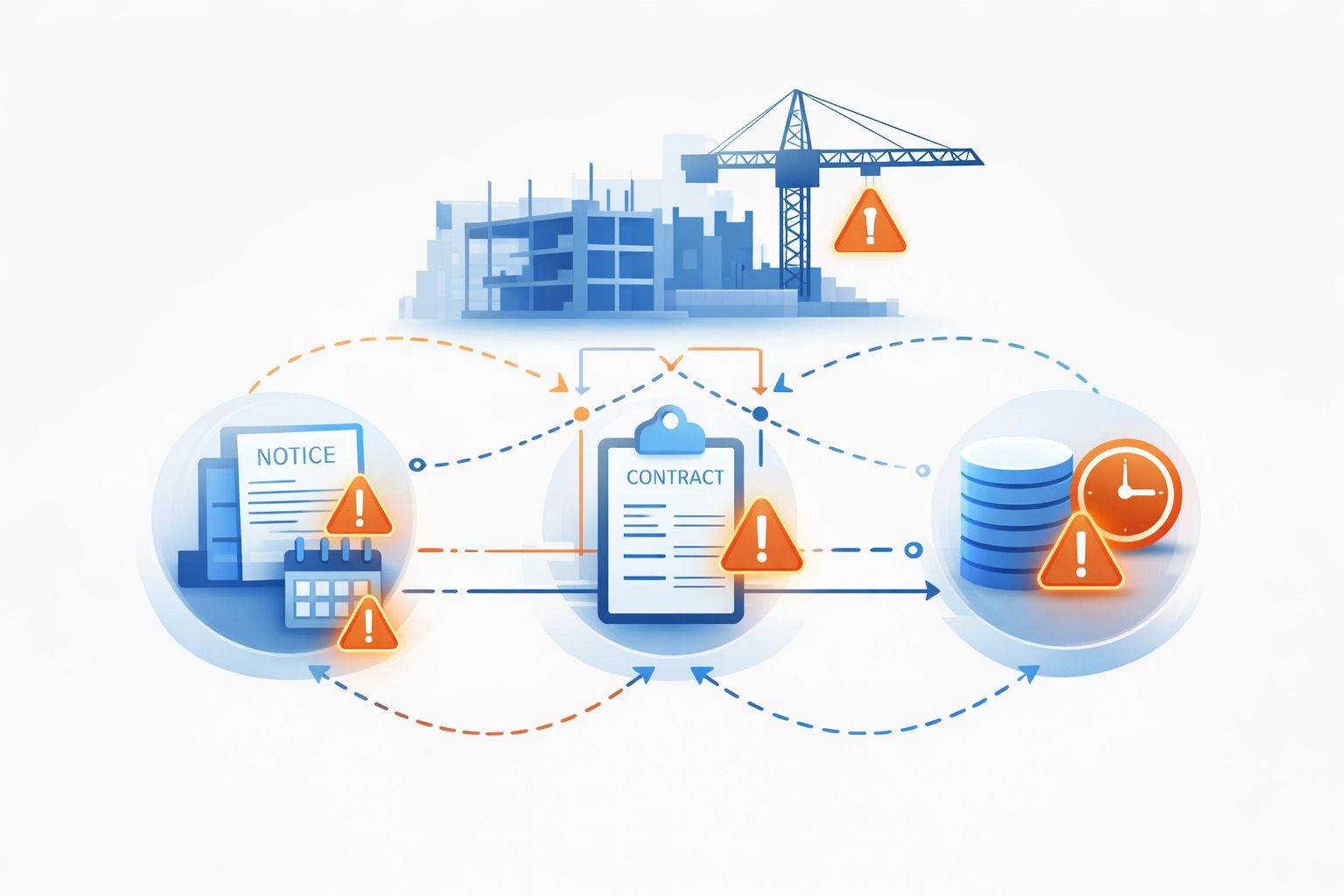
Execution does not create risk. It reveals the risk that already existed inside the construction contract structure.
That is why improving the contract review process before mobilization is critical.
How can the contract review process be strengthened to reduce risk?
By shifting from repeated reading to structured visibility.
Effective construction contract management requires understanding how obligations, commercial terms, and technical provisions operate together across the entire agreement.
This means identifying:
- Cross-clause dependencies
- Conflicting responsibilities
- Notice timing conflicts
- Payment trigger inconsistencies
- Scope definition mismatches
Without structured analysis, these interaction risks remain difficult to see.
Reducing legal risk in construction contracts requires systemic clarity, not just additional reviewers.
How does construction AI reduce contract risk in construction?
Modern construction AI enhances structural visibility.
Instead of treating contracts as static documents, AI processes them into structured intelligence. It can extract obligations, identify dependencies, compare amendments, and maintain traceability to original clause language.
This strengthens construction contract management by:
- Reducing manual searching across fragmented documents
- Improving cross-clause comparison
- Supporting faster risk identification
- Preserving source-linked validation for audit confidence
AI does not replace professional judgment. It reduces cognitive load so professionals can focus on high-impact decisions.
When integrated properly into the contract review process, structured analysis lowers contract risk in construction before execution begins.
Where does structured contract intelligence fit in modern construction workflows?
In document-heavy environments, information is distributed across storage systems, portals, revisions, and legacy archives.
Manual cross-referencing creates latency. Latency increases exposure.
Structured construction AI platforms like Bob support construction workflows by enabling teams to interact directly with contract content, analyze amendments, and validate obligations with traceable references.
This improves clarity without disrupting governance structures.
The outcome is a more stable construction contract management, reduced dispute probability, and earlier identification of legal risk in construction contracts.
What are the early warning signs of hidden contract risk in construction?
Projects that experience frequent disputes despite multiple reviews often exhibit:
Ambiguous responsibility definitions.
Notice clauses triggered differently than expected.
Payment timelines are dependent on loosely defined deliverables.
Scope interpretations vary across stakeholders.
These signals indicate structural misalignment within the construction contract.
Identifying them early reduces downstream escalation cycles.
What happens when contract risk in construction is identified early?
If your contracts go through multiple reviews but still result in disputes, the problem is unlikely to be effort.
It is visibility.
Modern construction contract management requires more than repeated reading. It requires structured analysis that can surface clause interactions, commercial dependencies, and notice triggers before execution begins.
This is where structured contract intelligence becomes practical.
Bob's dedicated Contract Analysis Agent is designed specifically for construction workflows. The contract analysis agent extracts obligations, identifies risk-sensitive clauses, compares amendments against base agreements, and maintains traceable links back to the original language. This strengthens the contract review process without removing professional judgment.
Instead of discovering exposure during execution, teams can identify contract risk in construction while there is still time to act.
Clear obligations reduce ambiguity.
Structured visibility reduces escalation.
Early risk detection protects execution.
Ready to experience intelligence in your contracts?
If your next project depends on stronger contractual clarity, do not wait for execution to reveal hidden exposure.
Walk through a live contract scenario. See how structured analysis surfaces interaction risk across amendments and base clauses.
Before your next mobilization, strengthen how you review contracts.
Because reducing contract risk in construction is not about reviewing more.
It is about seeing more.