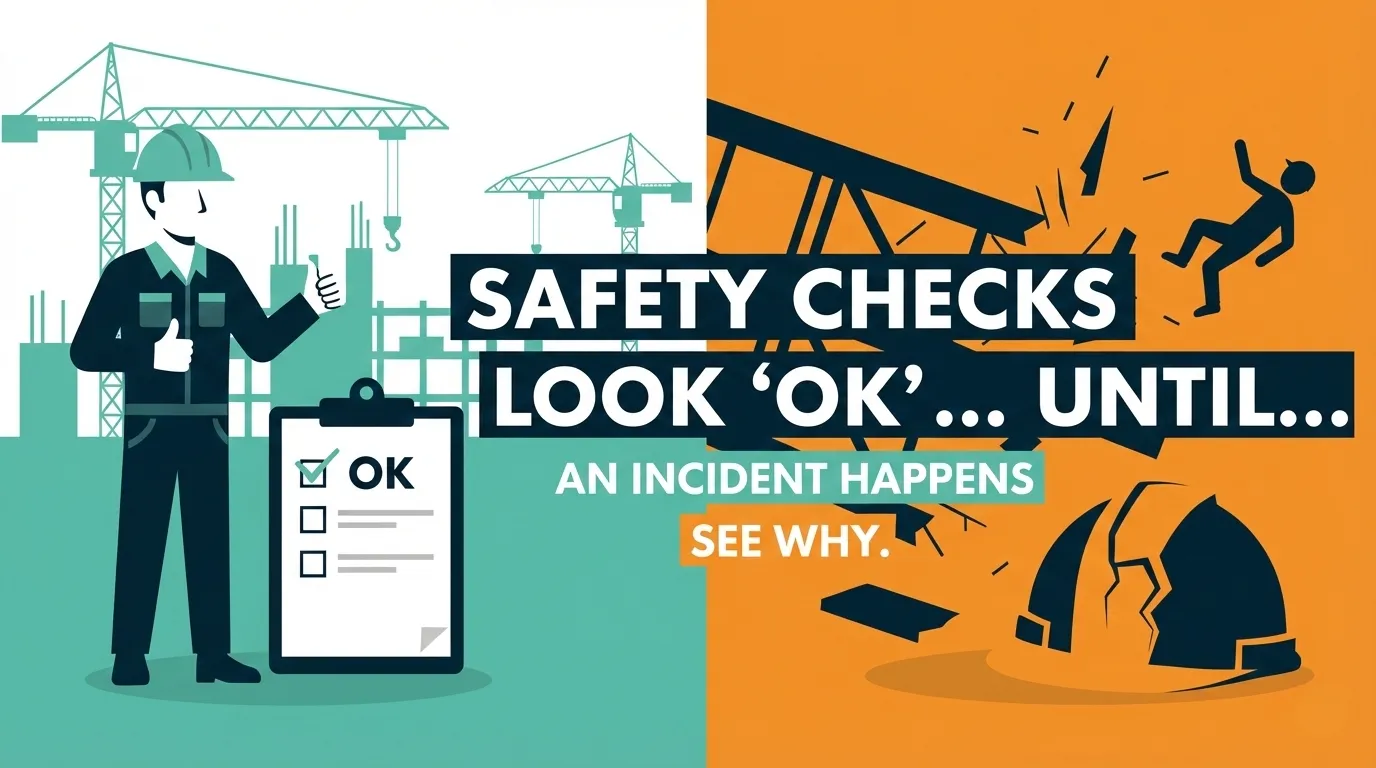
On most construction projects, safety appears to be under control.
Safety registers are updated by the safety officer, supervisors complete inspections during routine site walks, and project managers review dashboards that show no open issues. In review meetings, safety often moves quickly down the agenda because the records suggest everything is fine.
Then an incident happens.
- Then the same records suddenly feel inadequate.
- The site engineer reviews recent inspection logs.
- The safety officer looks for missed observations.
- The project manager asks where the process failed.
What becomes clear is not that inspections were skipped, but that the inspections did not reflect how work was actually unfolding on site.
This is why construction safety checks often look “ok” until an incident forces everyone to look closer. Learn why safety inspections miss changing site risks and how execution-linked safety prevents them.
Why safety checks appear reassuring
Safety checks feel reassuring because they are structured, repeatable, and visible. Teams conduct safety inspections at defined intervals, capture photos, and submit reports on time. From a management perspective, this creates confidence that safety is being handled.
The issue begins when repetition replaces attention. Many construction safety checks rely on fixed questions that remain the same even when site conditions change. The checklist confirms whether a control exists, not whether it still works for the specific activity happening that day.
For example, a barricade may be present during inspection, so it gets marked as compliant. Later in the day, the work zone shifts, equipment moves closer, or another contractor starts work nearby. The inspection does not update, but the risk profile has changed. The report still shows “no issues,” even though conditions are no longer the same.
Over time, teams begin to expect clean reports. Supervisors stop anticipating findings. Project managers see consistent green indicators and assume risk is low. Compliance starts to feel like control, even though construction site safety depends on live conditions, not completed forms.
The gap between safety reporting and site reality
Construction execution rarely stays still. Crews move between areas, activities overlap, and temporary arrangements remain in place longer than planned. Each of these changes directly affects construction site safety.
Safety reporting, however, often treats the site as if it were static. Most safety inspections get recorded independently of execution data. Observations are logged without being linked to a specific activity, work zone, or sequence step.
When inspections exist separately from execution, risks lose context. A safety observation sits in a report, while work continues on the ground. The site engineer sees progress moving ahead, but the inspection does not influence what happens next.
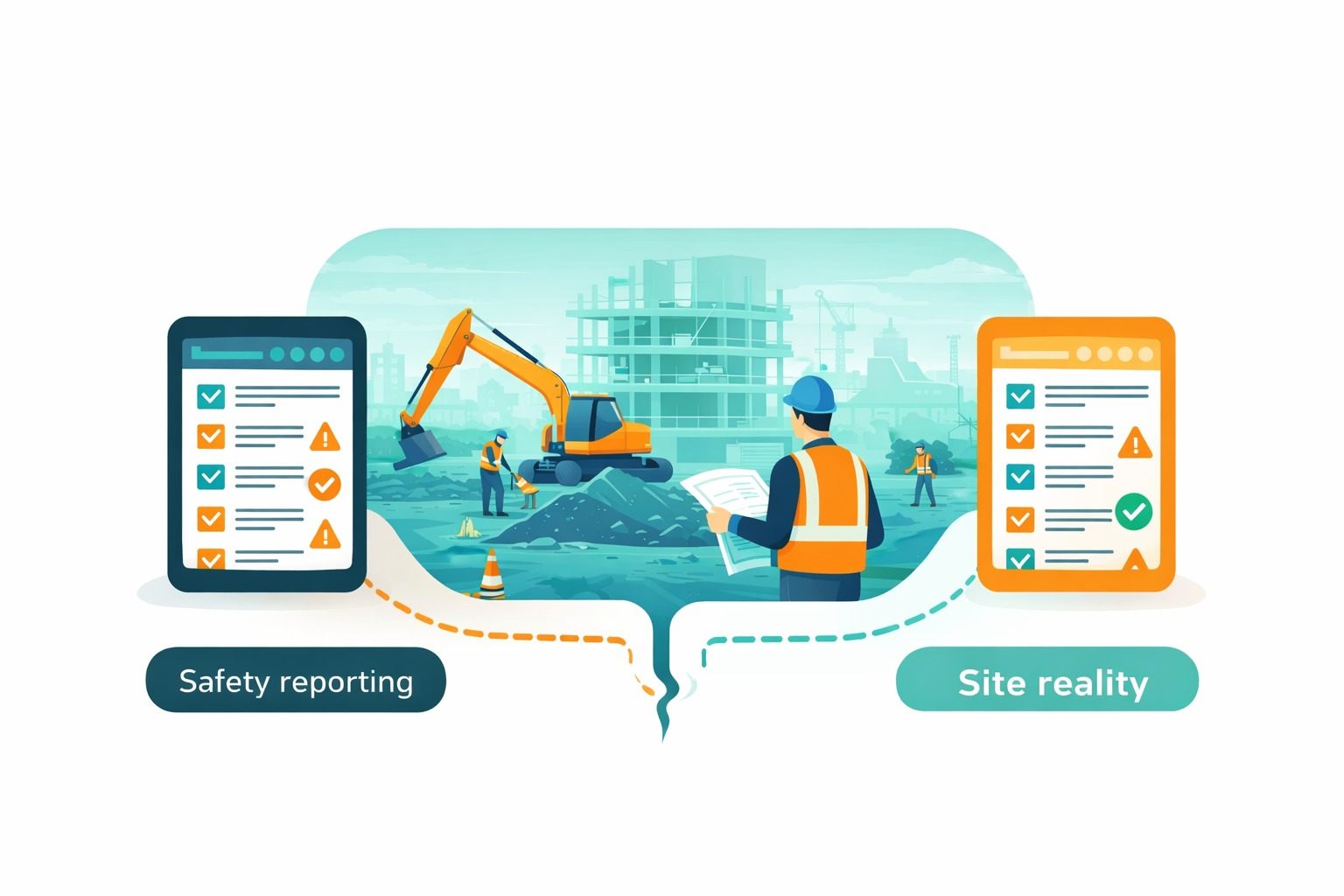
This disconnect weakens construction safety checks. The inspection reflects conditions at the time of the walk, not the conditions under which work continues afterward. Risks evolve faster than reports, and inspections fail to surface emerging hazards when teams still have time to act.
How warning signs get normalized
Incidents rarely begin with major violations. They usually start with small, unsafe conditions that feel manageable.
During inspections, teams record minor issues and mark them as low priority. The same issue appears again in the next inspection. It appears again after that. Each time, it gets recorded, and work continues.
When issues repeat without escalation, teams begin to adapt. Supervisors plan work around the risk. Workers adjust their behavior. Temporary fixes become permanent habits. Over time, unsafe conditions stop feeling urgent and start feeling normal.
This is how site safety issues become embedded in daily execution. The system records observations, but it does not force resolution. Construction safety checks continue to show activity, while risk remains active on site.
Why incidents feel sudden but aren’t
When an incident occurs, it often feels unexpected to the site team. From the outside, it looks like a single failure.
In reality, incidents usually result from accumulated risk. Each unresolved issue felt small on its own. None seemed serious enough to stop work. But together, they reduced the safety margin.
After the incident, teams often recognise that the warning signs were present in earlier safety inspections. The data existed, but it was scattered across reports and disconnected from decision-making.
For construction site safety, the problem is not the absence of information, but the absence of timely visibility where decisions are made.
Why traditional safety tracking falls short
Traditional safety tracking systems focus on documenting inspections. Paper registers and standalone digital logs capture safety inspections, but they struggle to drive action.
Issues get recorded, but follow-up depends on reminders from safety officers. Ownership is often unclear between supervisors, engineers, and contractors. Work continues even when observations remain open.
Most traditional systems do not connect construction safety checks to the work sequence. They describe what was observed, but they do not influence what happens next. As a result, projects can appear compliant while unresolved risks move forward with execution.
This limitation explains why many teams turn to construction safety management software. Not to replace safety roles, but to connect inspections, ownership, and closure directly to execution workflows.
The problem
The core problem is not missing a safety activity. Safety officers, supervisors, and engineers are conducting inspections. The issue is that construction safety checks operate independently of execution.
Teams document issues, but they do not actively manage them through closure. Early warning signs remain buried in routine reporting while site work continues. Safety becomes documentation rather than control.
The real issue
Incidents do not happen because safety checks are missing.
They happen because construction safety checks are not connected to execution.
The solution
Improving safety outcomes requires a clear shift in how inspections are used.
Teams need to treat safety inspections as part of execution, not as parallel reporting. Safety checks must link directly to activities and work zones so risks appear in context. Every issue must have clear ownership, and unresolved risks must remain visible before work progresses.
When safety data reflects live execution, teams see risk early enough to act. Accountability becomes clear, and prevention replaces reaction.
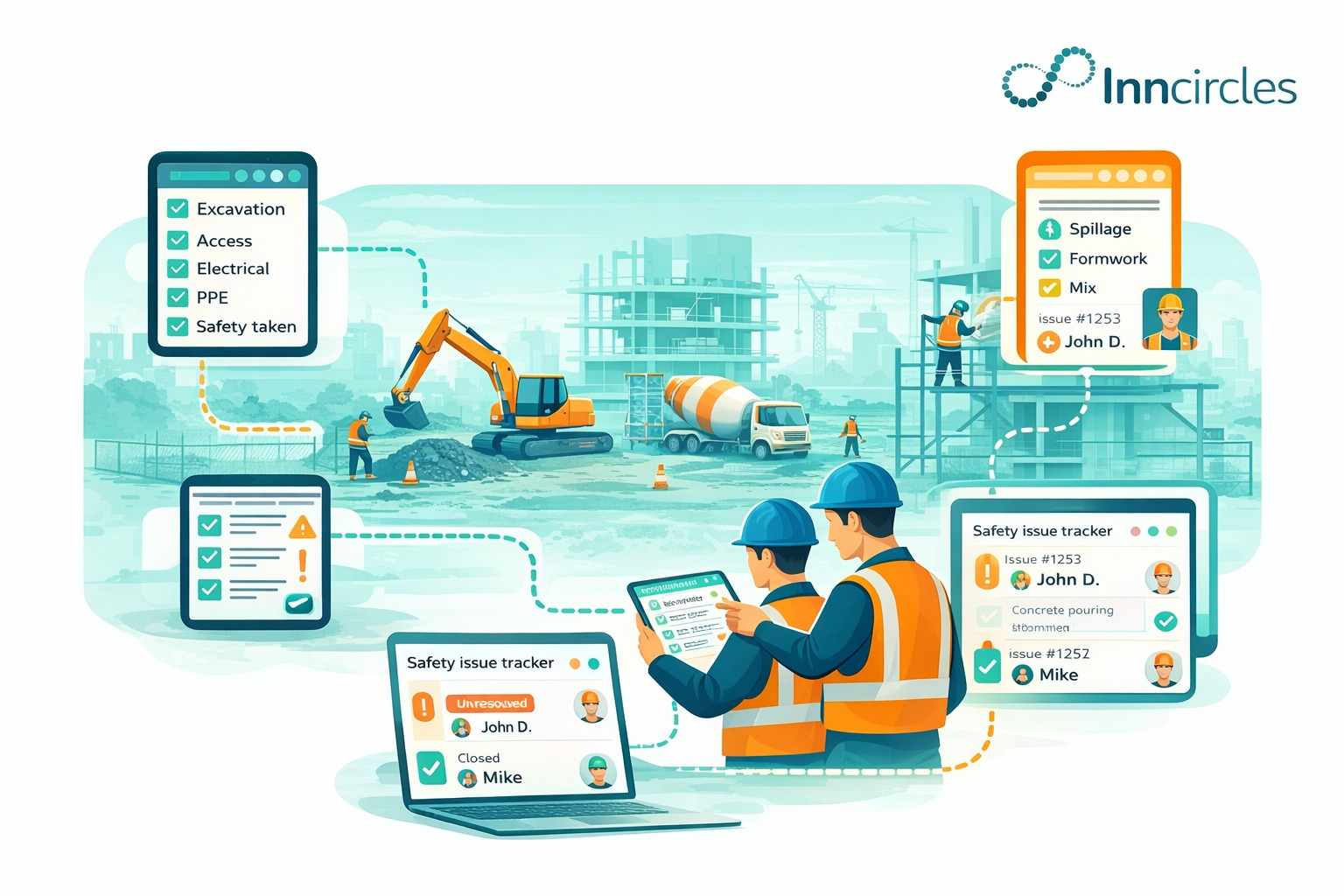
Inncircles construction safety management supports this approach by integrating safety inspections into execution workflows so teams surface risks early, track closure clearly, and avoid carrying unresolved hazards forward.
Making “ok” actually mean safe
Safety does not fail when an incident happens. It fails earlier, when warning signs become routine and “ok” becomes automatic.
The goal is not more inspections. The goal is to make safety inspections meaningful. That happens when inspections are connected to real activities, real locations, and real decisions made by site engineers and project managers.
Here is a simple check.
Do your construction safety checks influence what happens next on site, or do they only describe what already happened?
If they only describe, risk will always stay ahead.
When construction site safety is handled as part of execution, teams act earlier. Issues get closed. Incidents become less likely.
If you want to see how this works in real project workflows, explore how Inncircles connects safety with execution and decide if it reflects how your sites actually operate.