In construction projects, the monthly review meeting feels routine. The cost dashboard is mostly green, and commitments appear under control. Nothing feels urgent.
Then, a few weeks later, the same project is flagged for major cost overruns in construction.
What changed was not the work happening on site. What changed was awareness.
Cost overruns in construction do not show up all at once. They begin quietly through small productivity losses, minor quantity deviations, delayed approvals, variation work orders, and everyday execution decisions that seem manageable at the time. By the time these signals appear in cost reports, the overrun has already taken shape.
What teams notice late is not the issue itself, but the point at which it becomes visible.
Cost overruns in construction start quietly and are caught late. Learn why this happens and how better cost visibility helps teams act earlier.
Why do cost overruns in construction not announce themselves?
Most construction cost overruns do not begin with a clear warning.
During execution, small deviations are part of normal project delivery. Productivity varies. Quantities shift slightly. Approvals take longer than planned. Teams adjust and move forward to keep work progressing.
Variation work orders are another common source. A new scope is often introduced during execution to address site conditions, design clarifications, or stakeholder requests. While each variation may appear justified and necessary, it introduces additional quantities, labor, and materials that directly impact the budget.
Each of these issues feels contained. They are handled locally and rarely escalated. Because they appear manageable on their own, they do not trigger concern.
The problem is how they add up. Over time, these small deviations accumulate. When they are not connected back to cost in a timely way, project cost overruns develop quietly, without drawing attention.
On-site, overlapping work items add further complexity. When multiple trades operate in the same area without clear alignment, confusion increases. In some cases, completed work must be dismantled or reworked due to sequencing conflicts or miscommunication. Demolition and rework introduce unplanned labor, material waste, and schedule delays that silently push costs higher.
That is why cost overruns in construction often feel sudden, even though they have been building for weeks or months.
The time lag between execution and cost visibility
Site execution happens every day. Cost visibility usually does not.
Most projects capture execution data periodically. Quantities, productivity, and progress are recorded after work is completed. Cost updates follow on a weekly or monthly cycle.
This delay creates a blind spot. During this time, cost overruns in construction can grow without being seen. By the time execution data reaches the cost system, the related work is already finished.
Quality checks add another layer of risk. When completed work fails to meet quality standards, it must be redone. Rework increases material consumption, labor hours, and equipment usage, all of which create unplanned costs. These quality-related overruns often surface only after inspections, long after the original execution decisions were made.
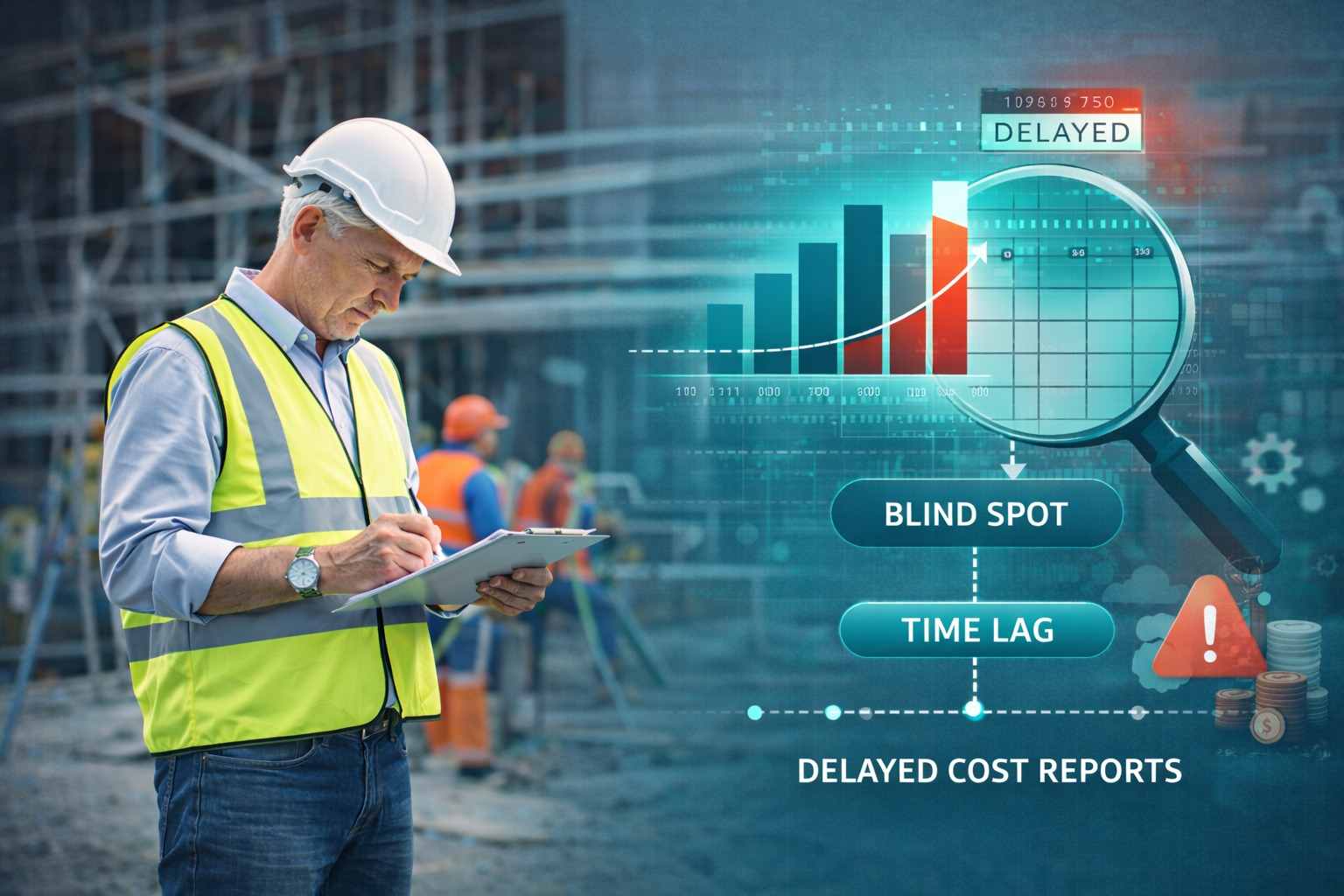
Without real-time cost tracking, teams are always looking backward. Early warning signs exist during execution, but they remain hidden until reporting cycles catch up. This time lag weakens construction cost control and delays action.
How weak actuals distort forecasts
Forecasts depend on execution data. When that data is delayed or incomplete, forecasts lose accuracy.
If actual quantities are not captured precisely and productivity data is generalized, construction forecasting starts relying more on assumptions than on reality. Forecasts continue to show alignment with the plan, even as execution moves off track.
Bottlenecks on-site accelerate this problem. Delays caused by material shortages, trade dependencies, or access constraints slow down progress. To recover lost time, teams often deploy additional labor or extend working hours. While this may protect the schedule, it introduces extra cost that was not planned or forecasted.
This gap grows over time. When accurate actuals finally enter the system, the correction is sudden. Weak actuals reduce forecast reliability and make construction cost control reactive instead of proactive.
The cost of late detection
The problem
Once cost overruns in construction become visible, recovery options are limited.
By this stage, variation work orders have already added new scope, quality failures have resulted in rework, and overlapping activities may have led to demolition or redo work. Bottlenecks slow execution, and teams often respond by adding labor or extending shifts to protect timelines, increasing cost in the process.
Execution delays also affect handover. Late completion can trigger penalties from regulatory authorities such as RERA, converting schedule slippage into direct financial loss.
At this point, construction cost control shifts from prevention to explanation and mitigation.
The real issue
Cost overruns are not sudden.
They are invisible for too long.
Execution data, quality outcomes, variation scope, and productivity losses are captured after work is completed. Cost updates follow later. During this gap, construction cost overruns continue to build while reports remain stable.
Because actuals arrive late, construction forecasting continues to assume alignment with the plan, even as execution moves off track. When accurate data finally enters the system, the impact is already locked in.
The solution
Preventing overruns requires an effective cost management construction software that connects execution to cost as work happens.
An effective cost management construction software captures quantities, productivity, variation scope, rework, and progress in real time. This allows construction cost control and construction forecasting to reflect execution reality immediately.
Inncircles is an effective cost management construction software designed to unify execution data and cost signals in a single system.

By reducing the gap between site activity and visibility, its integrated construction software enables earlier detection of cost overruns in construction, while corrective action is still possible.
Why traditional cost management falls short
Many projects still rely on periodic reporting to manage costs.
Execution data is captured separately. Cost data is updated later. Forecasts depend on delayed inputs.
Variation work orders, rework due to quality failures, site bottlenecks, and overlapping activities are tracked in different systems or informal processes. Early signals remain scattered across teams and tools. This disconnect ensures that construction cost overruns are identified only after their financial impact is already in place.
The real issue is not that overruns are sudden.
They are invisible for too long.
The role of effective cost management in construction software
Preventing overruns requires an effective cost management construction software that connects execution to cost as work happens.
An effective cost management construction software captures quantities, productivity, consumption, variation scope, rework, and site progress in real time. This data feeds directly into construction cost control and construction forecasting, creating visibility at the activity and work package level.
When execution changes, costs update immediately. When quality failures occur, rework is reflected instantly. When bottlenecks form, their cost impact becomes visible before corrective actions escalate expenses.
Inncircles is an effective cost management construction software designed to bring execution data, cost signals, and project controls into one connected system. By reducing the gap between execution and cost visibility, Inncircles helps teams identify cost overruns in construction early, while corrective action is still possible.
Closing thought
Cost control rarely fails because teams are not tracking data.
It fails because the data arrives too late to influence decisions.
By the time cost overruns in construction appear in reports, the execution choices that caused them are already in the past. At that point, teams are left managing impact instead of preventing it.
Early visibility changes this dynamic. When execution data connects directly to cost, teams can see deviations as they form, not after they are finalized. That shift allows project teams to act while options still exist and costs are still controllable.
This is where an effective cost management construction software becomes critical.
Inncircles helps teams move cost control closer to execution by unifying quantities, productivity, variation scope, quality outcomes, and cost data into a single system.
Its integrated construction software enables earlier detection of cost overruns in construction, stronger construction cost control, and more reliable construction forecasting.
When visibility improves, control improves. And cost overruns stop being surprises.
If preventing overruns matters more than explaining them, it is time to rethink how cost visibility is managed.